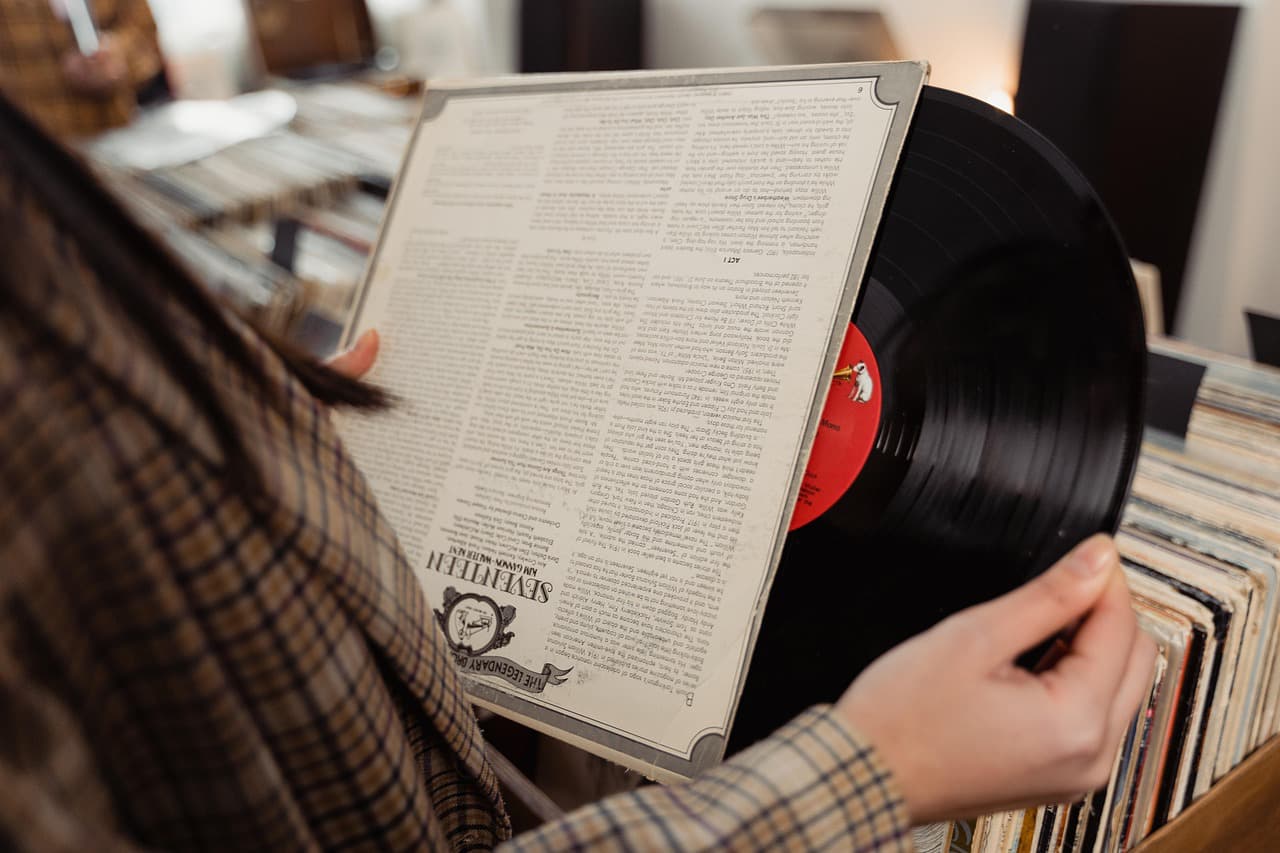
People always talk about nostalgia like it’s just an old song stuck in your head. In reality, it is more like a living echo that colours how we see the present. That is why when someone drops a needle on a record, even young listeners who never owned a turntable feel a pull.
You know how smelling a childhood perfume suddenly brings back an entire summer? Vinyl does something similar with sound. It takes us back to a time when listening was an event rather than background noise.
From Early Shellac to the First True LPs
Before vinyl became the format everyone recognises today, records were heavy shellac discs. They broke easily and carried only a few minutes of music per side. The post-war invention of the 33⅓ rpm long-playing record changed everything. Suddenly, albums could flow as complete works rather than disconnected singles.
Artists began to think in terms of concepts and sequences. This shift, subtle as it seemed at first, shaped how we now imagine “classic albums.” The Beatles, Miles Davis, and Aretha Franklin all built their masterpieces on this expanded canvas.
The Era When Vinyl Was King of the Living Room
By the 1960s and 70s, the record player had become the centrepiece of the home. People didn’t just listen; they gathered, debated cover art, and argued about which track should be played next.
You can picture the scene: shag carpet, a stack of sleeves leaning against the speaker, maybe a cat sleeping on the warm amplifier.
Music ownership was tactile. Flipping a record required intention. It slowed you down in a way that made each listen feel like a small ritual. Even the occasional pop or crackle felt like part of the performance.
The Fall to Cassettes and Compact Discs
Then came portability and the promise of “perfect sound forever.” Cassettes, despite their hiss, could travel in a car or a Walkman. CDs offered a clean, shiny future. Vinyl looked bulky and dated next to those little discs. Record stores shrank their LP sections.
By the late 1990s, it was hard to find a turntable outside a DJ booth. People traded warmth for convenience without much thought. The wheel of technology had turned, and, for a while, it seemed vinyl had rolled off the road entirely.
The Underground Kept the Groove Alive
What most people forget is that vinyl never fully disappeared. Small labels kept pressing limited runs for DJs, punk bands, and audiophiles. In dusty basement shops and at flea markets, collectors still flipped through crates, looking for lost gems.
That subculture preserved the knowledge of pressing plants, sleeve design, and even the art of cutting a master lacquer.
Without that stubborn community, the skills needed to revive vinyl would have been lost. It’s like heirloom seeds in agriculture; someone has to keep planting them even when the market turns away.
The Modern Resurgence and Why It Feels Different
Today, vinyl sales are climbing every year. Teenagers who grew up with streaming are buying records of artists they first discovered on their phones. It isn’t just about sound quality, though many argue that analog feels warmer. It’s about experience.
A record gives you large-scale artwork, liner notes you can actually read, and the satisfying weight of something real in your hands.
Stores hold listening events. Limited coloured pressings sell out in hours. Even mainstream retailers carry turntables again. This is not simply nostalgia; it is a desire to slow down and connect, to make music listening deliberate instead of disposable.
The Emotional Pull of Holding Music in Your Hands
When you slide a new record from its sleeve, brush away the dust, and place it on the platter, you are performing a small ceremony. It demands attention. That action tells your brain: this matters. Digital playlists rarely create that same signal.
For many people, especially younger listeners, vinyl isn’t about going back to their parents’ era.
It’s about building their own rituals in a world where everything else feels instant and intangible. In a way, the comeback of vinyl is less about the past than about our hunger for something present, something weighty, something that moves at human speed.